
 By Rehan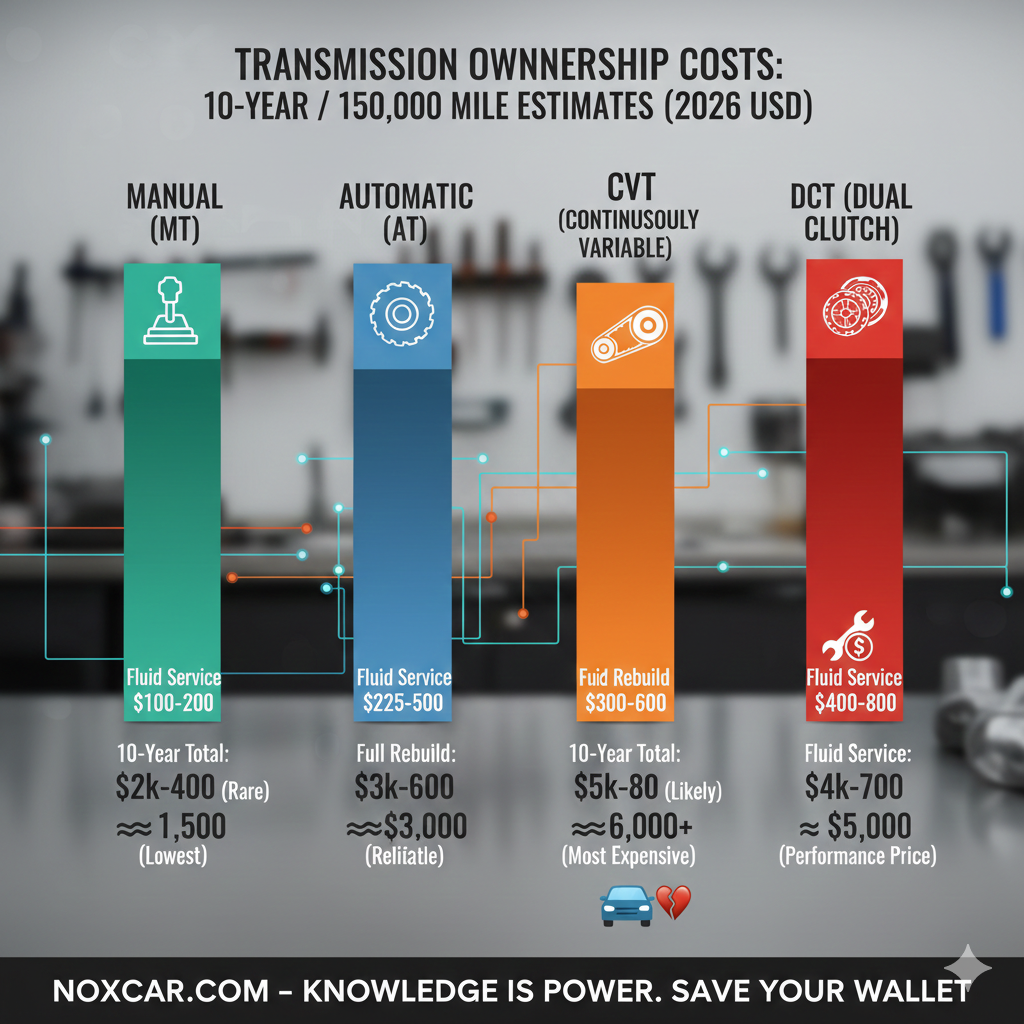
You’re cruising down the interstate when it happens—a slight shudder, a momentary slip in power, or a faint whine from under the hood. Your heart sinks. You glance at the odometer: 112,000 miles. Is this the end, or just a simple fluid flush?
In this transmission longevity comparison, we’re stripping away the manufacturer sales fluff to look at the cold, hard data. Most car owners are unknowingly driving on a “ticking time bomb” simply because they fell for the industry’s biggest marketing lie: “Lifetime Transmission Fluid.” > Whether you’re rowing gears in a Manual, enjoying the seamless pull of a CVT, or feeling the snap of a DCT, your gearbox is fighting a silent war against heat. But which one actually survives the long haul? Is the “old school” Manual still the king of 300,000 miles, or have modern 10-speed Automatics finally closed the gap?
By the end of this guide, you’ll know which transmission will save your wallet—and which one is destined to break it.
Transmission Mechanics
Manual (MT)
A manual transmission (MT) is the simplest type of transmission, consisting of a gearbox with a driver-operated clutch. This setup requires the driver to manually engage and disengage the clutch when shifting gears, giving the driver full control over the vehicle’s power delivery. The simplicity of the manual transmission is one of its key advantages—it has fewer moving parts compared to more complex transmission types, which makes it less prone to failure and more durable over time.
An excellent example of a durable manual transmission is the Honda Civic Si’s 6-speed manual. Known for its reliability, this transmission offers smooth shifting and longevity due to its low parts count. With basic maintenance, a manual transmission can often last between 200,000-300,000 miles or more, making it one of the longest-lasting options available.
Automatic (AT, Torque Converter)
The automatic transmission (AT), often featuring a torque converter, uses a fluid-coupled planetary gear system to automatically shift gears based on speed and load. This setup allows for a smoother driving experience without the need for a clutch pedal, making it a popular choice for daily driving and commercial vehicles. The torque converter helps transmit engine power to the wheels by using fluid to connect the engine and the transmission, providing seamless gear shifts and smooth acceleration.
A notable example of automatic transmissions in trucks is the GM 10L90 and ZF 8HP, both of which are commonly found in vehicles like the Ford F-150. These systems are known for their reliability and can easily handle the demands of heavy-duty driving, with proper maintenance. When well-maintained, automatic transmissions can last between 150,000-250,000 miles, and sometimes even beyond 400,000 miles.
CVT (Continuously Variable Transmission)
The Continuously Variable Transmission (CVT) operates differently from traditional automatic transmissions. Rather than using a set number of gears, a CVT uses a belt and pulley system to provide an “infinite” number of gear ratios. This allows the engine to operate more efficiently by adjusting the power delivery seamlessly without any noticeable shifting. The result is a smooth driving experience, often leading to better fuel economy.
CVTs are commonly found in vehicles like the Nissan Rogue and Subaru models. While they provide excellent fuel efficiency, especially during steady cruising, they are known to be sensitive to heat—particularly in stop-and-go traffic. Prolonged heat exposure can lead to belt wear, which is a common issue with CVTs, and one of the primary reasons their lifespan is often shorter than traditional transmissions. On average, CVTs can last around 100,000-150,000 miles, with some exceptions reaching 200,000 miles with proper care.
DCT (Dual Clutch Transmission)
The Dual Clutch Transmission (DCT) uses two separate clutches, one for odd gears and one for even gears, allowing for rapid gear shifts. This type of transmission is commonly found in sporty vehicles and high-performance cars, such as the VW Golf GTI and BMW M DCT. The DCT provides extremely fast gear changes, resulting in better acceleration and driving dynamics compared to other transmission types.
However, DCTs are more complex and require more maintenance than manual or automatic transmissions. The two clutches and the sophisticated control systems can wear out over time, especially if the transmission is frequently subjected to high-stress driving, such as during racing or heavy acceleration. On average, DCTs can last between 120,000-200,000 miles, but they may experience issues like clutch wear or mechatronic unit failures without proper care. Regular fluid changes and software updates are essential to keep a DCT running smoothly.
Longevity Data (US Miles, Repair Shop/Owner Stats)
Manual (MT)
-
Average Lifespan: 200k-300k+ miles
- Manual transmissions are known for their durability, and with proper maintenance, they can easily surpass 200,000 miles. In fact, many manual transmissions are still running smoothly well beyond 300,000 miles, especially in vehicles that are used for regular commuting and light driving.
-
Common Failure: Clutch replacement ($1k-2k)
- The most common issue with manual transmissions is the clutch, which wears out over time due to friction. Replacing the clutch typically costs between $1,000 and $2,000, depending on the vehicle and labor costs. The rest of the transmission components, however, tend to last much longer with minimal issues.
-
Example: Honda Accord MT, Miata MX-5
- These vehicles are great examples of manual transmission longevity. Honda Accords and Mazda Miata MX-5s with manual gearboxes often last well over 200k miles, and many owners report their cars running well beyond this mark with basic maintenance. Their simplicity and low parts count contribute to their long lifespan.
Automatic (Torque Converter)
-
Average Lifespan: 150k-250k miles
- Automatic transmissions with torque converters generally last between 150,000 and 250,000 miles, but this can vary depending on the type of vehicle, usage, and maintenance. With proper care, such as fluid changes and timely repairs, some automatic transmissions can last well beyond 250,000 miles.
-
Common Failure: Valve body/solenoids ($2k-4k)
- A common issue with automatic transmissions is valve body or solenoid failure, which controls the shifting of gears. When these parts fail, the cost of repair can be significant, ranging from $2,000 to $4,000, depending on the vehicle and the complexity of the repair.
-
Example: Ford 10R80 in Mustang/F-150
- The Ford 10R80 transmission, found in vehicles like the Ford Mustang and F-150, is a reliable automatic transmission that can reach 200,000 miles or more with proper maintenance. This 10-speed torque converter transmission is known for its smooth shifts and high durability.
CVT (Continuously Variable Transmission)
-
Average Lifespan: 100k-150k miles
- CVTs generally have a shorter lifespan compared to other transmissions, averaging around 100,000 to 150,000 miles. This is primarily due to the belt and pulley system they use, which can experience wear and tear much faster than the components found in manual or automatic transmissions.
-
Common Failure: Belt/pulley issues ($4k-7k)
- The primary issue with CVTs is belt and pulley failure, which can be quite expensive to fix. Replacing the belt or pulley can cost between $4,000 and $7,000, making CVT repairs some of the priciest in the automotive world. These issues are often exacerbated by overheating or driving in stop-and-go traffic for prolonged periods.
-
Example: Nissan Altima/Rogue
- Nissan’s CVTs, found in models like the Altima and Rogue, are notorious for early failure. Many owners report issues requiring repair or replacement of the transmission by 120,000 miles. This has led to class-action lawsuits and extended warranties for these vehicles. However, newer CVTs have been improved, and some post-2018 models have seen better reliability.
DCT (Dual Clutch Transmission)
-
Average Lifespan: 120k-200k miles
- Dual Clutch Transmissions (DCTs) typically last between 120,000 and 200,000 miles, with performance often declining as the vehicle approaches the higher end of that range. These transmissions are designed for fast shifts and are often found in sports cars and performance vehicles, which means they endure more stress during operation.
-
Common Failure: Mechatronics/clutches ($3k-6k)
- The most common failure in DCTs is related to the mechatronics unit or clutch system. The mechatronics unit controls the shifting mechanism and can be prone to wear and failure. Repairing or replacing the mechatronics unit can cost anywhere from $3,000 to $6,000, making it a costly repair. Additionally, the clutches in DCTs can wear out, especially if the car is frequently driven aggressively.
-
Example: VW/Audi DSG TSBs
- Volkswagen and Audi’s DSG (Direct-Shift Gearbox) has been praised for its quick shifts but also known for mechatronic failures after 100,000 miles. These issues are frequent enough that the DSG transmissions in many models, such as the VW Golf GTI and Audi A3, often come with extended warranties to cover repairs. When maintained well, however, these transmissions can last up to 150,000 miles or more.
Key Trade-Offs
Heat & Usage Impact
- Manual:
Manual transmissions thrive in a wide range of driving conditions, from highway cruising to city traffic. Their simplicity and direct control over gear shifting allow them to handle varied climates and driving situations with minimal wear. The lack of complex fluid systems or cooling requirements means manuals are less affected by external factors like heat or stop-and-go traffic, making them reliable for long-distance driving across the US, including in hot or cold environments. - Automatic:
Automatic transmissions, especially those with torque converters like the ZF 8HP, excel on highways and interstates. They offer smooth, consistent shifting during steady driving, which helps improve fuel efficiency and comfort. This is why automatic transmissions are commonly found in long-haul vehicles and taxis. For instance, the ZF 8HP transmission used in vehicles like the BMW 5 Series and Chrysler 300 can easily last up to 300,000 miles in taxi fleets, where they endure hours of continuous highway driving. However, in stop-and-go traffic, automatic transmissions can experience heat buildup due to constant engagement, which can lead to wear over time if not properly maintained. - CVT:
CVTs are designed for smooth operation and efficiency, but they tend to struggle in heavy stop-and-go traffic. The constant shifting between infinite gear ratios can cause the transmission belt and pulleys to overheat, especially in cities like Los Angeles or New York where traffic congestion and high ambient temperatures are common. Vehicles with CVTs, like the Nissan Altima and Rogue, have been known to experience premature belt failure due to these conditions, particularly in hot climates where the transmission faces added stress. This heat sensitivity is a key reason why CVTs often have a shorter lifespan compared to manual or automatic transmissions in urban driving environments. - DCT:
Dual Clutch Transmissions (DCTs) are known for their quick shifting and are widely used in performance vehicles. However, these transmissions require cooldown periods after high-stress situations like racing or track use. DCTs can handle the intense heat generated by rapid shifts during high-performance driving, but without proper cooling, they can suffer from clutch wear and mechatronics issues. This makes DCTs less ideal for heavy city traffic, as their cooldown needs can become a concern. High temperatures from extended use or aggressive driving can also lead to failure if not properly managed.
Winter Salt & Corrosion
- Automatic:
Automatic transmissions are more prone to corrosion in cold climates, particularly due to winter salt used on the roads. The salt can accelerate corrosion in the transmission components, especially in cold, wet conditions where moisture can accumulate. This issue is common in regions like the Midwest and Northeast where roads are salted during the winter months. To prevent damage, automatic transmissions require regular fluid flushes and maintenance to ensure that the transmission fluid remains clean and free of contaminants. Failing to do so can lead to clogged valves, solenoid malfunctions, and fluid breakdown, reducing the transmission’s lifespan.
Maintenance Schedules
Manual (MT)
- Clutch Fluid:
For manual transmissions, regular maintenance is essential to ensure the clutch operates smoothly. Clutch fluid should be changed every 60,000 miles, with a typical cost of around $100. While clutch fluid is relatively inexpensive, maintaining it is critical for proper clutch function and avoiding potential problems, like clutch slippage or difficulty shifting. - Gearbox Oil:
Another key maintenance task is changing the gearbox oil. This should typically be done every 50,000 miles, costing around $150. Changing the oil ensures that the gears are properly lubricated, preventing wear and ensuring smooth shifting. While the maintenance cost is lower compared to other transmission types, it’s still important to stay on top of this to avoid any long-term issues.
Automatic (AT, Torque Converter)
- Fluid/Filter Changes:
Automatic transmissions require more attention when it comes to fluid maintenance. Fluid and filter changes should be done every 60,000 to 100,000 miles, with costs typically ranging from $250 to $500, depending on the vehicle and type of transmission. Regular fluid changes help maintain the performance of the transmission by ensuring that the fluid remains clean and free of debris, which can damage internal components. - Special Fluids for Longevity:
Some automatic transmissions, like those with ZF or Lifeguard systems, require special fluids to maintain longevity. These fluids are designed to withstand high temperatures and pressures, extending the life of the transmission. While they are more expensive, using the correct fluid is crucial to avoid premature wear or failure.
CVT (Continuously Variable Transmission)
- NS-3 Fluid:
For CVTs, fluid maintenance is crucial for preventing overheating and maintaining smooth operation. NS-3 fluid, the specific fluid used in many CVTs, should be changed every 30,000 to 60,000 miles, costing between $200 and $400. Regular fluid changes help prevent belt or pulley failure, one of the most common issues with CVTs. - Belt Inspection:
The CVT belt is a critical component, and while it’s not always necessary to replace it frequently, yearly inspections are recommended to check for wear and tear. Over time, the belt can become damaged, especially in high-stress driving conditions like stop-and-go traffic, which can lead to costly repairs if not addressed early.
DCT (Dual Clutch Transmission)
- Dual Fluid Changes:
DCTs require dual fluid changes—one for the clutch and one for the transmission fluid—every 40,000 miles, with a typical cost of $400 or more. These fluid changes are essential for keeping the dual-clutch system functioning properly, as they help maintain the lubrication and cooling necessary for the fast shifting that DCTs are known for. Neglecting fluid changes can lead to poor performance, slipping, or even clutch failure. - Software Updates:
Unlike traditional transmissions, DCTs also rely heavily on software to control shifting and clutch engagement. As a result, software updates are critical to maintaining optimal performance. Failing to update the software can result in erratic shifting behavior and poor performance. Depending on the manufacturer, these updates may need to be performed at a dealership or qualified service center.
Real-World Examples
Manual Champion
- Mazda Miata (NC/ND) Manuals:
The Mazda Miata, particularly the NC and ND models, is a standout when it comes to manual transmission longevity. Many owners report their Miatas running smoothly past 300,000 miles, with regular maintenance, especially for the clutch and gearbox oil. The simplicity and reliability of the 6-speed manual transmission contribute to its long lifespan, making the Miata a trusted manual champion. - Honda Civic Si (10th Gen):
The Honda Civic Si (10th generation), another manual transmission icon, also stands out for its durability. Civic Si manuals are often found in taxi fleets or high-mileage vehicles, with many reaching 250,000 miles without significant transmission issues. With routine clutch maintenance and oil changes, these vehicles consistently perform well well beyond the 200k-mile mark, showcasing the resilience of Honda’s 6-speed manual transmissions.
Automatic Reliability
- GM 8L90/10L90 in Trucks:
GM’s 8L90 and 10L90 automatic transmissions are used in heavy-duty trucks like the Chevrolet Silverado and GMC Sierra. These transmissions are built for performance and reliability, with many trucks easily hitting 200,000 miles without major transmission issues. Regular fluid changes and maintenance can push these systems even further, with some trucks running smoothly up to 300,000 miles. The torque converter design, paired with a smooth shifting experience, makes the GM automatic a reliable choice for workhorse vehicles. - Toyota A750 in Older Tacomas:
The Toyota A750 automatic transmission, found in older Toyota Tacoma models, is widely regarded as one of the most durable automatic transmissions. With proper maintenance, many Tacomas with this transmission have reached an impressive 400,000 miles without significant transmission failure. This long-lasting reliability has earned the Toyota A750 a reputation for low maintenance costs and high dependability, especially in rugged environments like construction or off-roading.
CVT Warning
- Nissan CVT (2013-2020):
Nissan CVTs, particularly in models like the Altima and Rogue, have gained notoriety for premature failures, often around 120,000 miles. This issue has been significant enough to prompt class-action lawsuits and extended warranties for many vehicles affected by CVT belt/pulley failure. While Nissan has made strides to improve their CVT technology, earlier models still face issues with overheating and belt wear in heavy traffic or high-stress driving conditions, significantly impacting their lifespan. - Subaru CVTs:
Subaru’s CVTs, such as those found in the Subaru Outback and Forester, have seen improvements in durability and performance post-2018. However, CVT reliability issues still persist, especially in earlier models. While Subaru has introduced more robust designs in their post-2018 vehicles, the CVT belt remains vulnerable to wear, particularly in stop-and-go traffic or when towing. Maintenance, such as fluid changes, is crucial to extending the lifespan of these transmissions, but CVTs still face challenges compared to their automatic counterparts.
DCT Durability
- BMW DCTs:
BMW’s Dual-Clutch Transmission (DCT), commonly found in high-performance models like the BMW M3 and M5, offers incredibly fast gear shifts, making them a favorite in the performance car world. With proper care and maintenance, BMW’s DCTs can last up to 150,000 miles, and some owners report extending this lifespan with regular fluid changes and clutch adjustments. These transmissions are built for sporty performance, and as long as they are treated with care, they can deliver impressive durability. - VW/Audi DSG Mechatronics Issues:
Volkswagen and Audi’s Direct-Shift Gearbox (DSG), particularly the 02E DSG, is known for its quick shifting and smooth performance. However, mechatronics (the control system of the DSG) are a common failure point, typically around 100,000 miles. The mechatronics unit can fail due to wear and tear or improper maintenance, leading to erratic shifting or complete transmission failure. Fortunately, many models come with extended warranties to cover these issues. Despite this, the DSG’s complexity and need for specialized care make it less reliable than traditional automatic transmissions.
Ownership Costs (2026 Estimates)
When considering the long-term ownership costs of a vehicle, it’s important to factor in not just the purchase price, but also the maintenance and repair costs over time. Each type of transmission has different needs in terms of fluid services, full rebuilds, and overall maintenance expenses. Here’s a breakdown of the expected ownership costs for each transmission type over a 10-year period (assuming 150,000 miles of driving).
Manual (MT)
- Fluid Service:
For manual transmissions, fluid service is typically straightforward and inexpensive. You can expect to spend around $100 to $200 for routine clutch fluid and gearbox oil changes every 60,000 to 100,000 miles. - Full Rebuild:
Manual transmissions are generally quite durable, and full rebuilds are rare. If needed, the cost for a full rebuild will range from $2,000 to $4,000, depending on the vehicle and the extent of the repair. - 10-Year Total (150k miles):
Over a 10-year period, including regular fluid changes and occasional repairs, the total ownership cost for a manual transmission is approximately $1,500. This makes manual transmissions relatively affordable to maintain compared to their automatic counterparts.
Automatic (AT, Torque Converter)
- Fluid Service:
Automatic transmissions require more frequent and expensive fluid services than manual transmissions. Expect to pay between $250 and $500 for fluid and filter changes every 60,000 to 100,000 miles. - Full Rebuild:
When it comes to repairs, automatic transmissions are more complex, and a full rebuild can be expensive. The cost typically ranges from $3,000 to $6,000, depending on the model and the severity of the issue. - 10-Year Total (150k miles):
Over a 10-year period, you can expect to spend about $3,000 on fluid services and repairs for an automatic transmission. While automatic transmissions are convenient and offer smooth shifting, they come with higher maintenance costs due to their complexity.
CVT (Continuously Variable Transmission)
- Fluid Service:
CVTs require special fluid, such as NS-3 fluid, and typically need service every 30,000 to 60,000 miles. Expect to spend between $300 and $600 for each fluid service. - Full Rebuild:
CVTs can be prone to issues like belt/pulley failures, which can be costly to repair. A full rebuild for a CVT usually costs between $5,000 and $8,000, due to the complexity of the belt and pulley system. - 10-Year Total (150k miles):
Over a 10-year period, you may spend $6,000+ on fluid services and full rebuilds. Given their vulnerability to wear, CVTs can be much more expensive to maintain and repair compared to manual and automatic transmissions.
DCT (Dual Clutch Transmission)
- Fluid Service:
DCTs require dual fluid changes for both the clutch and transmission fluids. These services generally occur every 40,000 miles, with a typical cost of $400 to $800. Regular fluid changes are essential to avoid costly damage to the clutches and mechatronics. - Full Rebuild:
If a DCT experiences issues, such as mechatronics failure or clutch wear, the cost of a full rebuild can range from $4,000 to $7,000. DCTs are complex systems that require specialized maintenance and repairs, which can make them more expensive to service. - 10-Year Total (150k miles):
Over 10 years, the total cost of ownership for a DCT, including fluid changes and potential repairs, is estimated at around $5,000. While DCTs offer excellent performance, they come with higher maintenance and repair costs compared to traditional automatic and manual transmissions.
Pros/Cons
When it comes to choosing a transmission, the decision often boils down to a few key factors: longevity, repair costs, fuel economy, and resale value. Here’s a breakdown of how each transmission type compares across these important aspects, with a focus on US buyers’ priorities.
| Aspect | Manual | Automatic | CVT | DCT |
| Longevity | Top (simple) | Strong (proven) | Weakest (belts) | Good (needs TLC) |
| Repair Costs | Lowest | Moderate | Highest | High (specialized) |
| Fuel Economy | Neutral | Best multi-speed | Excellent (steady RPM) | Sporty but thirsty |
| Resale Value | High (enthusiast) | Highest (convenience) | Low (failure fears) | Middling (rep issues) |
Longevity
- Manual transmissions are known for their exceptional longevity. Due to their simple design, they have fewer parts that can wear out, leading to a long lifespan with minimal issues. Manuals can last between 200,000 to 300,000 miles and even beyond with proper maintenance.
- Automatic transmissions are proven to last a long time as well, especially models like the ZF 8HP or GM 10L90. With proper fluid changes and regular maintenance, automatics can last between 150,000 to 250,000 miles, with some reaching 300,000 miles.
- CVTs generally have the weakest longevity due to their reliance on belts and pulleys, which are prone to wear, especially under heavy use or heat. Their average lifespan is between 100,000 to 150,000 miles, and they often fail prematurely due to belt wear.
- DCTs offer good longevity when properly maintained but need extra care due to their complexity. They can last around 120,000 to 200,000 miles, but neglecting maintenance or subjecting them to high-stress driving can cause issues.

Repair Costs
- Manual transmissions have the lowest repair costs because of their simple design. Most repair work typically involves clutch replacement (around $1,000 to $2,000) or gearbox oil changes. These costs are much more affordable compared to other transmission types.
- Automatic transmissions can be more expensive to repair, with costs ranging from $2,000 to $4,000 for issues like valve body or solenoid failure. However, they tend to be more reliable than CVTs and DCTs, meaning fewer repairs are required overall.
- CVTs are the most expensive to repair, with belt and pulley failures costing between $4,000 and $7,000. The complex nature of CVTs also means they are more prone to issues and require specialized repair services.
- DCTs have high repair costs, typically ranging from $3,000 to $6,000 for issues like mechatronics failure or clutch replacement. These systems are more complex, requiring specialized parts and expertise, making repairs more costly.
Fuel Economy
- Manual transmissions provide neutral fuel economy compared to other types. While they don’t have the efficiency advantages of CVTs or automatics, their fuel consumption is generally in line with other vehicles, depending on driving conditions.
- Automatic transmissions excel in fuel efficiency, particularly with modern multi-speed systems. With 8-speed or 10-speed automatics, such as the ZF 8HP in vehicles like the BMW 5 Series, they can achieve excellent fuel economy at higher speeds or cruising conditions, especially when paired with a hybrid powertrain.
- CVTs are known for their excellent fuel economy, especially during steady-state driving, because they keep the engine operating at its optimal RPM for fuel efficiency. Their infinite gear ratios provide smooth, efficient performance without constant gear shifts.
- DCTs, while offering sporty performance, tend to be thirstier in terms of fuel consumption. The focus on quick, aggressive shifting sacrifices some fuel economy, especially in urban stop-and-go driving. However, they are still more efficient than older automatic transmissions.
Resale Value
- Manual transmissions hold high resale value among enthusiast buyers who appreciate the engagement and control they offer. Vehicles like the Mazda Miata or Honda Civic Si with manual gearboxes tend to have a strong resale market, even as their overall numbers decrease in the market.
- Automatic transmissions have the highest resale value in the general market due to their convenience and ease of use. Most buyers prefer automatics for everyday driving, making them more popular in the resale market.
- CVTs generally have lower resale value because of their reliability concerns. Buyers are often hesitant to purchase vehicles with CVTs, especially after hearing about failure issues in models like the Nissan Altima or Rogue.
- DCTs have middling resale value due to reputation issues with their complexity and the potential for mechatronic or clutch failure. While performance buyers appreciate the fast shifting, the higher maintenance costs can deter some buyers from purchasing a used DCT-equipped vehicle.
Future Trends
As the automotive industry continues to evolve, so do the technologies behind vehicle transmissions. The future is shaping up to bring exciting advancements, particularly in hybrid powertrains and high-performance automatic transmissions. Here’s a look at some of the key trends that are likely to dominate the US market in the coming years:
eCVTs in Hybrid Vehicles
One of the most notable advancements in the transmission world is the rise of eCVTs (electronic CVTs), especially in hybrid vehicles. eCVTs are taking over from traditional CVTs in many modern hybrid powertrains, providing greater efficiency and reliability. Unlike traditional CVTs, which use a belt and pulley system, eCVTs combine electric motor assistance with a more sophisticated setup, allowing for smoother power delivery and better performance under various driving conditions.
Vehicles like the Toyota Prius and Rav4 Hybrid are prime examples of this trend. The eCVT in these models has proven to be highly durable, with many drivers reporting a lifespan of up to 300,000 miles or more. The integration of electric motors allows these vehicles to operate more efficiently, especially in stop-and-go traffic, while still delivering excellent fuel economy. With continued advancements in battery technology and electric motors, we can expect eCVTs to become even more reliable and long-lasting in the future, solidifying their place in hybrid vehicles.
10+ Speed Automatics
Another exciting development is the rise of 10+ speed automatic transmissions in both light-duty and heavy-duty vehicles. Manufacturers like Allison Transmission are pushing the boundaries of what’s possible with automatic gearboxes. The Allison 10-speed transmission, for example, is already making waves in heavy-duty trucks like the Chevrolet Silverado HD and Ford Super Duty models. These transmissions are engineered for optimal power delivery, efficiency, and longevity, even under the demanding conditions of towing and hauling.
The 10+ speed automatic systems offer seamless shifting, improving fuel efficiency by keeping the engine running at its optimal RPM more frequently. They also offer better acceleration and higher towing capacities, which are crucial for commercial trucks. Thanks to the combination of advanced materials, refined engineering, and improved transmission controls, these high-speed automatics are increasingly capable of lasting well beyond 500,000 miles when properly maintained. This makes them ideal for long-haul trucking, where reliability and durability are paramount.
Conclusion
In this comparison of manual, automatic, CVT, and DCT transmissions, we’ve seen how each type offers distinct pros and cons when it comes to longevity, maintenance costs, and performance. Let’s recap:
- Manual Transmissions (MT) are the champions of longevity, with simple designs that can easily last 200,000 to 300,000 miles or more with proper maintenance. They have the lowest repair costs but are less convenient than automatics. Perfect for those who value long-term reliability and driving engagement. However, the clutch will need to be replaced periodically, typically around $1,000 to $2,000.
- Automatic Transmissions (AT), especially those with torque converters, provide smooth shifting and convenience, making them the go-to option for drivers who prioritize ease of use. While their lifespan ranges from 150,000 to 250,000 miles, they come with moderate repair costs (e.g., valve body or solenoid failures) and require regular fluid and filter changes. Automatic transmissions excel on highways, offering superior fuel economy compared to older designs, but they can become costly to maintain in the long term.
- CVTs are known for fuel efficiency, offering smooth acceleration and better economy in urban and highway driving, but they are often the weakest in terms of longevity. They typically last between 100,000 and 150,000 miles, with belt and pulley failures being the most common issue. While they’re great for fuel savings, they come with higher repair costs, especially when the belt or pulley system needs replacement. CVTs are ideal for those who prioritize fuel economy, but buyers should be cautious, especially in heavy traffic or hot climates where they are more prone to failure.
- Dual Clutch Transmissions (DCT) offer sporty performance with quick gear shifts and excellent acceleration. However, they require more specialized care and higher maintenance costs. DCTs typically last 120,000 to 200,000 miles and are prone to clutch wear or mechatronic failures if not properly maintained. DCTs are perfect for those seeking a high-performance driving experience, but careful maintenance is essential to extend their lifespan.
What Should You Choose?
Ultimately, your decision should be guided by your priorities:
- If long-term reliability and low maintenance costs are your top priorities, then manual transmissions are your best bet.
- If you value convenience, ease of use, and smooth shifting, automatic transmissions will likely suit your needs best.
- For those who want the best fuel efficiency, CVTs are the way to go, but be sure to monitor their performance, especially in heavy traffic or harsh climates.
- If sporty performance is your focus, and you’re willing to invest in careful maintenance, DCTs provide the quickest shifts and best performance, but they come with higher repair costs and more complexity.
By understanding the trade-offs between these transmissions, you can make a more informed decision that aligns with your driving style, budget, and maintenance preferences. Whether you’re seeking reliability, fuel efficiency, performance, or convenience, there’s a transmission type that fits your needs.