
 By Rehan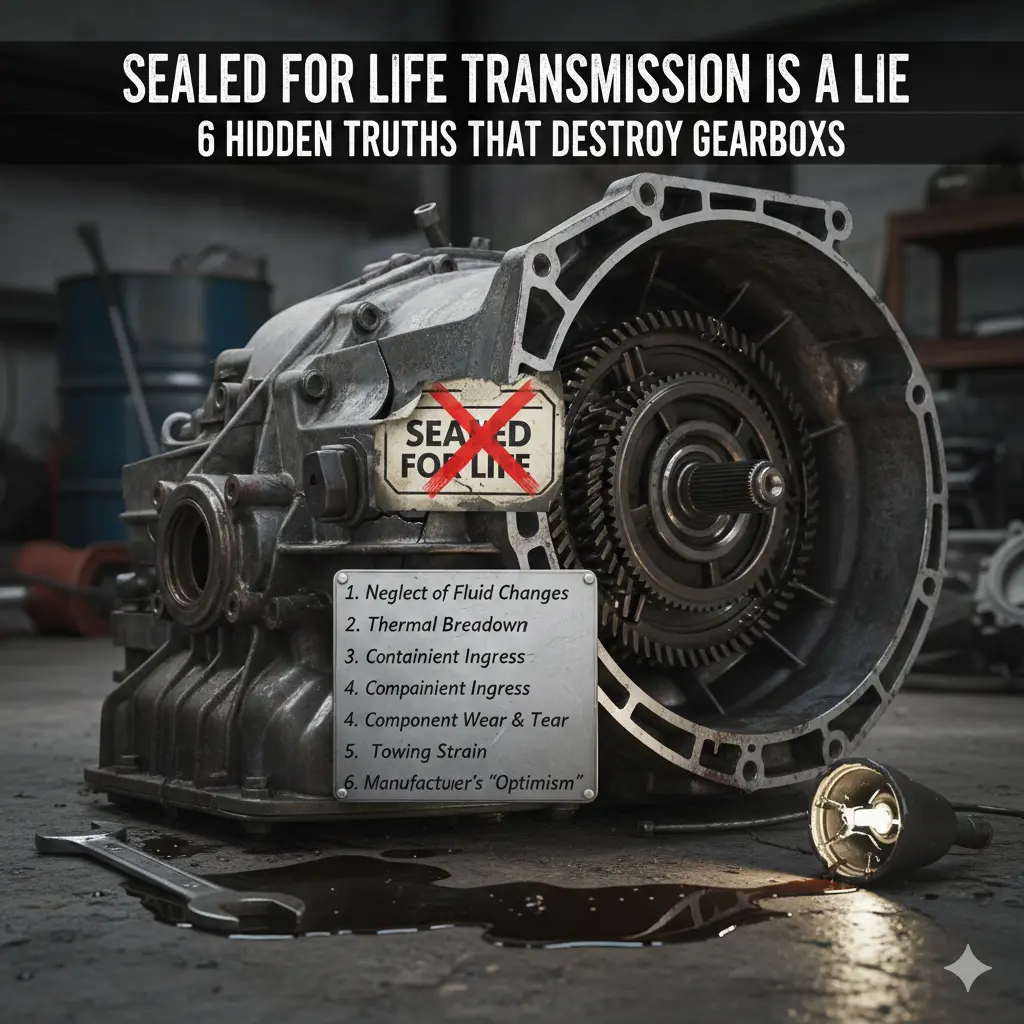
If you drive a modern vehicle, you’ve probably seen the reassuring label stamped somewhere on the transmission: “Sealed for Life.” It sounds comforting. It suggests precision engineering, zero maintenance, and a drivetrain built to last forever. But here’s the uncomfortable truth: that label may be one of the most expensive myths in modern automotive ownership.
The idea of a sealed for life transmission promises convenience and lower maintenance costs. Yet in real-world workshops, technicians regularly see “lifetime” transmissions failing before 150,000 miles—often with repair bills exceeding $5,000. The contradiction is clear. What manufacturers define as “lifetime” and what owners expect from their vehicles are rarely the same thing.
This article exposes the reality behind sealed transmissions. We’ll explain what “lifetime” actually means in engineering terms, why transmission fluid still degrades, and how neglecting service quietly destroys gearboxes. By the end, you’ll know how to protect your transmission and what it really takes to make it last 300,000 km or more.
Is “Sealed for Life” Transmission Fluid Really Lifetime?
No. A sealed for life transmission is designed to survive the warranty period, not the full mechanical lifespan of the vehicle.
Transmission fluid is a working fluid. It cools components, transfers hydraulic pressure, and lubricates gears and clutch packs. Over time, heat, friction, and shear forces break it down. Additives deplete, viscosity drops, and microscopic metal particles accumulate. Once this happens, the fluid can no longer protect precision parts like solenoids, valve bodies, and clutch surfaces.
Real-world data shows transmissions last far longer when fluid is replaced every 50,000–80,000 miles—even in units marketed as sealed. Ignoring service doesn’t preserve the transmission; it accelerates wear silently until failure becomes unavoidable.
The Sealed for Life Transmission Myth Explained
There is no such thing as a permanent lubricant in a system exposed to heat and friction. The phrase “sealed for life” is not a physical law—it’s a marketing construct.
Manufacturers use statistical survival models that assume most vehicles will be sold, scrapped, or replaced before long-term failure becomes their problem. From an engineering standpoint, the transmission is considered “successful” if it survives the first owner and warranty window.
That definition has nothing to do with your long-term ownership goals.Transmission life and engine life go hand in hand. If you want a 300,000 km car, understanding engine longevity factors is just as critical.
Why Manufacturers Avoid Fluid Change Recommendations
Recommending fewer service items lowers the advertised Total Cost of Ownership (TCO). Fleet buyers, leasing companies, and showroom shoppers respond positively to “maintenance-free” claims.
Removing transmission service from maintenance schedules artificially reduces ownership costs for the first 5–7 years. The failure risk is shifted to the second or third owner—someone else’s problem.
This is not about engineering superiority. It’s about accounting optics.
Transmission Maker vs Car Brand — Who Tells the Truth?
The clearest evidence of the lifetime myth appears when you compare car brands with the companies that actually build the transmissions.
| Car Brand Claim | Transmission Manufacturer Recommendation |
|---|---|
| BMW: Lifetime fill | ZF: Service every 50k–75k miles |
| Toyota: Sealed unit | Aisin: Fluid every 20,000 km |
| Mercedes (1990s): Lifetime | Later revised to 40k–77k miles |
Transmission manufacturers design for durability. Car brands market for sales. When the two disagree, follow the engineers, not the brochure.
BMW markets its ZF 8-speed automatic as a “lifetime fill” unit, yet ZF—the company that actually designed and built the transmission—recommends regular fluid service every 50,000–75,000 miles to maintain proper shifting and long-term durability, as outlined in their official service guidance.
Should You Change Transmission Fluid After 100k Miles?
Yes. The myth that fresh fluid causes slipping is reverse causality.
Most owners wait until the transmission starts acting up before servicing it. When the unit fails shortly afterward, the fluid change gets blamed—even though the damage was done years earlier.
Old fluid doesn’t “help clutches grip.” It acts as liquid sandpaper, damaging solenoids and valve bodies. Clean fluid restores proper hydraulic pressure and heat control. Hardened steel gears don’t need grit—they need lubrication.
Why CVT Transmissions Fail Faster Than Automatics
CVTs are far less forgiving than traditional automatics. They rely on extreme hydraulic pressure to keep a steel belt clamped between pulleys. Slight fluid degradation leads to belt slip, which permanently damages the pulley faces.
Critical CVT Warning Signs:
-
RPM hunting during steady cruising
-
Delayed engagement from Park to Drive
-
High-pitched whining noises
-
Overheating under light load
Addressing early symptoms within 500 miles can be the difference between a fluid service and a full replacement.
Transmission Flush vs Drain and Fill — What Actually Works
Modern “flush” machines are fluid exchangers, not pressure washers. They use the transmission’s own pump to replace fluid gradually.
For high-mileage units with unknown history, many specialists prefer drain and fill with a filter change. This replaces about 40% of the fluid at a time, avoiding sudden detergent shock.
The key isn’t the method—it’s changing the fluid at all.
Mechanic Insider Warning
Ask any transmission rebuilder what kills modern gearboxes and the answer is always the same: overheated, never-changed fluid.
Most failed transmissions we see at 120,000 miles still contain their factory fluid. The clutches didn’t fail suddenly—they wore out slowly while the owner trusted a lifetime label designed for first owners, not long-term drivers.
The Hidden Cost of “Lifetime” Marketing
The lifetime label is often justified as environmentally friendly. Fewer fluid changes mean less waste—on paper.
In reality, prematurely scrapping a 400-pound transmission is far worse for the environment than changing a few liters of oil. This is greenwashing, not sustainability.
Avoiding a $300 service often leads to a totaled vehicle.
Transmission Fluid Reality vs Marketing Claims
| Claim | Engineering Reality |
|---|---|
| Lifetime fluid | Breaks down from heat |
| Maintenance-free | Needs 50k–80k mile service |
| Sealed system | Still produces wear particles |
| Eco-friendly | Early failures increase waste |
| No service needed | $4k–$7k replacement later |
How to Make Your Transmission Last 300,000 km
The 300,000 km Transmission Survival Rule
If you want your transmission to outlive the average vehicle:
-
Change fluid every 50k–70k miles
-
Service CVTs every 30k–50k miles
-
Never ignore delayed shifting
-
Avoid lifetime fluid myths
-
Fix overheating immediately
Simple rules. Proven results.
Final Question Every Owner Must Answer
Is your vehicle an asset you want to keep for 10+ years…
or a disposable machine designed to survive only the warranty period?
Because one fluid change decision today determines whether your transmission becomes a 300,000-km survivor—or a $5,000 failure waiting quietly under the car.
Frequently Asked Questions
1. What does “sealed for life transmission” really mean?
A sealed for life transmission does not mean the fluid lasts forever. It usually means the fluid is expected to last through the warranty or first ownership period, typically around 100,000–150,000 miles. Over time, heat and friction break down transmission fluid, making service necessary for long-term reliability.
2. Should sealed transmission fluid ever be changed?
Yes. Most transmission specialists recommend changing fluid every 50,000–80,000 miles, even in sealed units. Regular fluid changes help prevent overheating, clutch wear, and internal damage that can lead to costly transmission failure.
3. Can changing transmission fluid damage an old transmission?
No. New transmission fluid does not cause failure. In most cases, transmissions fail after a fluid change because internal damage already existed due to years of neglected maintenance. Fresh fluid actually helps restore proper lubrication and cooling.
4. Why do CVT transmissions require more frequent fluid changes?
CVT transmissions rely heavily on fluid pressure and friction to operate. When fluid degrades, the belt can slip and damage the pulleys quickly. This is why CVT fluid should usually be replaced every 30,000–50,000 miles to prevent early failure.
5. How can I make my transmission last 300,000 km?
To extend transmission life, change fluid regularly, monitor for delayed shifting or overheating, service CVTs more frequently, and avoid believing lifetime fluid myths. Preventive maintenance is far cheaper than replacing a failed transmission.