 By Rehan
When it comes to automotive performance, three critical factors often come into play: horsepower vs torque vs gearing. These elements are the building blocks that determine how a vehicle accelerates, handles, and performs at high speeds. Each of these components plays a unique role, yet they are deeply interconnected, working in harmony to bring out the best in a vehicle’s capabilities.
Torque provides the rotational force needed to move a vehicle, especially when starting from a stop or accelerating at lower speeds. Horsepower, on the other hand, measures the rate at which that force is applied over time, allowing the vehicle to sustain speed and power at higher RPMs. Meanwhile, gearing determines how that power is transferred to the wheels, impacting how the engine’s output is utilized for either speed or acceleration, depending on the situation.
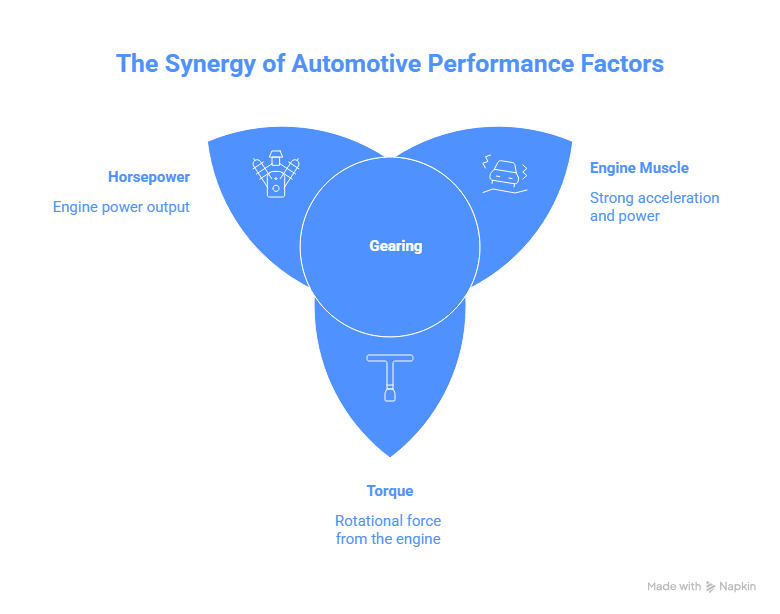
Together, these three factors shape how a vehicle performs on both the road and track, making it essential to understand their relationship to optimize performance. In this blog, we’ll break down each concept—horsepower, torque, and gearing—explaining what they are and how they work together to maximize vehicle efficiency and power. Whether you’re tuning your car for better acceleration or gearing it for top-speed performance, understanding this trio is key to getting the most out of your vehicle.
Torque is the twisting force an engine generates at the crankshaft, and it is essential for enabling vehicle acceleration. It’s the force that gets a car moving from a stop or helps it climb a hill. Torque is quantified in pound-feet (lb-ft), which measures the rotational force exerted by the engine on the crankshaft.
For example, when you press the gas pedal, the engine produces torque, which is then transmitted through the drivetrain to the wheels. This torque is what pushes the car forward, especially noticeable when you’re accelerating from a stop. Higher torque generally results in stronger acceleration, particularly at lower speeds, making it a crucial factor for vehicles that need to carry heavy loads or perform intense tasks like towing.
Horsepower, on the other hand, measures how quickly that torque performs work over time. It’s a function of both torque and engine speed (RPM), and is calculated using the formula:
HP=Torque×RPM5252text{HP} = frac{text{Torque} times text{RPM}}{5252}HP=5252Torque×RPM
Here, RPM represents the revolutions per minute of the engine. The relationship between RPM and torque in determining horsepower is crucial. The faster the engine spins (higher RPM) while maintaining the same amount of torque, the greater the horsepower. This explains why high-revving engines can often outperform low-RPM engines at sustained speeds.
In essence, horsepower indicates how efficiently an engine can apply its torque over time, while torque measures the actual force applied to achieve that movement. High horsepower engines are typically better for maintaining high speeds over long distances, while torque-focused engines are better suited for tasks requiring initial power or low-speed strength.
Gearing refers to the system of gear ratios in a vehicle’s transmission and differential. These ratios adjust how the engine’s torque is translated into wheel torque and speed. In simpler terms, gearing controls how the engine’s rotational force is delivered to the wheels, influencing acceleration and top speed.
Gear ratios in the transmission either multiply or reduce the engine’s torque, depending on the gear you are in. Lower gear ratios (e.g., 4:1) multiply the engine’s torque to the wheels, offering strong acceleration but limiting the vehicle’s top speed. Conversely, higher gear ratios (e.g., 1:1 or overdrive) reduce the amount of torque delivered to the wheels, but allow the car to achieve higher speeds at lower RPMs, making them more efficient for cruising.
For instance, in racing, a car might use shorter final drive ratios to keep the engine RPM high for quicker acceleration, but this sacrifices top-end speed. On the other hand, a vehicle intended for highway driving may use a taller gear ratio to keep the RPM lower, improving fuel efficiency while maintaining speed.
Horsepower is directly derived from both torque and RPM. It’s the result of the engine’s ability to deliver torque at a certain engine speed (RPM). To put it simply, horsepower represents how effectively the engine can apply torque over time.
The formula for calculating horsepower:
HP=Torque×RPM5252text{HP} = frac{text{Torque} times text{RPM}}{5252}HP=5252Torque×RPM
This equation highlights that higher RPM, when paired with steady torque, results in more horsepower. As engine speed increases, so does the amount of work done per unit of time, even if torque remains constant.
An example of this relationship can be seen when comparing high-revving engines to low-RPM, torquey engines. High-revving engines, like those found in sports cars, can generate more horsepower at higher RPMs even with relatively lower torque. These engines perform particularly well at sustained speeds, as the ability to rev high keeps horsepower levels up, allowing for better performance on highways and racetracks.
On the other hand, low-RPM, high-torque engines, such as those in trucks or diesel vehicles, excel at tasks requiring raw force like towing or hauling. However, these engines may struggle to maintain high speeds on highways, as the horsepower tends to drop off as RPM decreases, limiting their ability to sustain speed over long distances.
One critical point in automotive performance is matching engine characteristics with the appropriate gearing. Equal horsepower engines can perform similarly if geared properly. For instance, two engines producing the same horsepower, but with different torque characteristics, can behave differently depending on the transmission and gear ratios.
The role of gearing becomes evident when considering how raw engine torque might be limited without the right transmission setup. Without proper gearing, low-end torque might not be fully utilized in lower speeds, and high RPMs could fail to generate enough power without gear ratios that maintain peak horsepower. For example, a high-torque engine with long gear ratios (like in a diesel truck) might struggle to accelerate quickly, while a high-revving sports car engine might require shorter gears to maintain high RPMs for optimal performance.
This principle is supported by insights from Car and Driver, which explain how high-revving engines may outperform low-RPM engines in specific conditions despite the latter’s higher torque. Additionally, SCS Gearbox discusses how different gear ratios can either multiply torque for acceleration or reduce it to achieve better efficiency at cruising speeds.
In essence, matching the right gear ratios to engine torque and RPM characteristics ensures that the vehicle can perform at its best, whether you’re after acceleration, top speed, or fuel efficiency. Without proper gearing, even the most powerful engines can be constrained by their limitations at low or high speeds.
Gearing plays a crucial role in determining how engine power is transferred to the wheels, affecting a vehicle’s acceleration, top speed, and overall efficiency. The gear ratios in a vehicle’s transmission or differential dictate how the engine’s torque is delivered to the wheels. Depending on the gear ratio, the vehicle can either prioritize strong acceleration or higher speeds, with each choice impacting engine performance in different ways.
Lower gear ratios (higher numerically, like 4:1) are designed to multiply the engine’s torque to the wheels. This multiplication enhances acceleration, making it easier for the vehicle to accelerate quickly from a standstill or climb hills. The lower the gear ratio, the more torque is delivered to the wheels, providing strong initial power.
However, the downside is that lower gear ratios limit top speed. Because they force the engine to rev higher to achieve greater speed, the engine quickly reaches high RPMs, which is fine for acceleration but unsustainable for cruising at high speeds. This is why vehicles with low gear ratios are ideal for performance racing or towing, where rapid acceleration is needed, but not necessarily sustained high-speed travel.
For example, a vehicle with a 4:1 gear ratio will accelerate more quickly but will reach its top speed faster as the engine RPM rises more quickly compared to a vehicle with a higher gear ratio.
In contrast, higher gear ratios (like 1:1 or overdrive) reduce the amount of torque transferred to the wheels, but they allow the engine to operate at lower RPMs while achieving higher speeds. Essentially, these ratios reduce wheel torque but extend the vehicle’s ability to maintain speed without putting excessive strain on the engine. As a result, these ratios are ideal for highway driving or fuel efficiency, as they allow the vehicle to maintain high speeds at lower engine RPMs, helping preserve horsepower over extended periods of time.
For instance, in a highway driving scenario, a 1:1 gear ratio (or overdrive) allows the car to cruise efficiently at higher speeds without over-revving the engine. This improves fuel economy and reduces engine wear because the engine isn’t forced to operate at high RPMs for long stretches.
Shifting gears is integral to maintaining optimal RPM and ensuring the engine operates at or near peak horsepower. The primary purpose of shifting gears is to keep the engine’s RPM within the optimal power band for the task at hand. For example, during acceleration, the transmission shifts to lower gears, keeping the engine RPM high so that the engine can generate more power. In contrast, when driving at cruising speeds, shifting to a higher gear keeps the engine RPM lower, preserving efficiency.
The gear-shifting process allows the car to trade torque for speed without losing overall power. In lower gears, the engine’s torque is multiplied, giving the vehicle a powerful boost for acceleration, but as you shift to higher gears, the emphasis shifts to maintaining higher speeds with reduced torque demands. This balance ensures that the car doesn’t lose power during transitions but can still reach its top speed efficiently.
For example, a car in first gear has the maximum torque multiplication for quick starts, but as the car accelerates, shifting into higher gears reduces the torque multiplication and allows the vehicle to move faster at lower RPMs, helping sustain the vehicle’s power for longer durations.
- According to Lainefamily.com, the importance of gearing in trading torque for speed is demonstrated by how lower gears provide torque to get the car moving quickly, while higher gears help preserve horsepower and increase efficiency at higher speeds. This balance is essential for maintaining overall vehicle performance without excessive fuel consumption or engine stress.
- SCS Gearbox further supports this by explaining how gear ratios in racing vehicles use shorter gear ratios for rapid acceleration but shift to higher gears at sustained speeds to optimize horsepower. The choice of gearing is essential for different driving conditions—whether on a racetrack or cruising on the freeway.
The relationship between torque, horsepower, and gearing becomes more tangible when we look at different engine types and real-world scenarios. Each engine type has its own unique characteristics, and how these characteristics are paired with the right gear ratios can greatly influence performance, whether for highway cruising, hill climbing, or racing. Let’s dive into a few practical examples to see how these elements interact in different contexts.
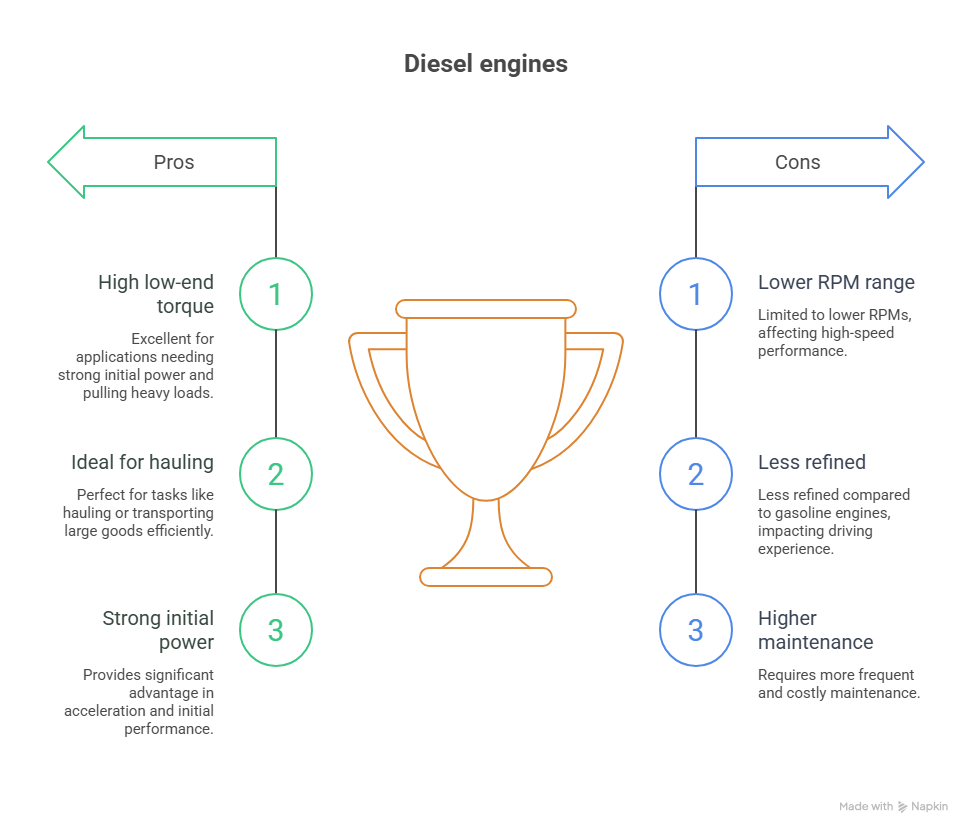
Diesel engines are known for their high low-end torque, which is ideal for applications requiring strong initial power. For example, a typical diesel engine might produce 400 lb-ft of torque at 2000 RPM, giving it a significant advantage in pulling heavy loads or towing. This high torque at relatively low RPMs makes diesel engines perfect for tasks like hauling or transporting large goods.
However, this low-end torque also means that diesel engines need tall gearing to operate efficiently at highway speeds. Tall gearing allows the engine to stay at lower RPMs while cruising at high speeds, maximizing fuel efficiency and preventing the engine from over-revving. Without tall gearing, the engine might be stuck at higher RPMs for long periods, causing unnecessary wear and lower fuel efficiency.
For example, a diesel-powered truck with a tall gear ratio (e.g., 3:1 or higher) will use the engine’s high torque to maintain highway speeds efficiently, without having to work too hard. This gear ratio allows for smooth cruising, where the engine can maintain low RPMs, optimizing fuel consumption while still providing plenty of power when needed.
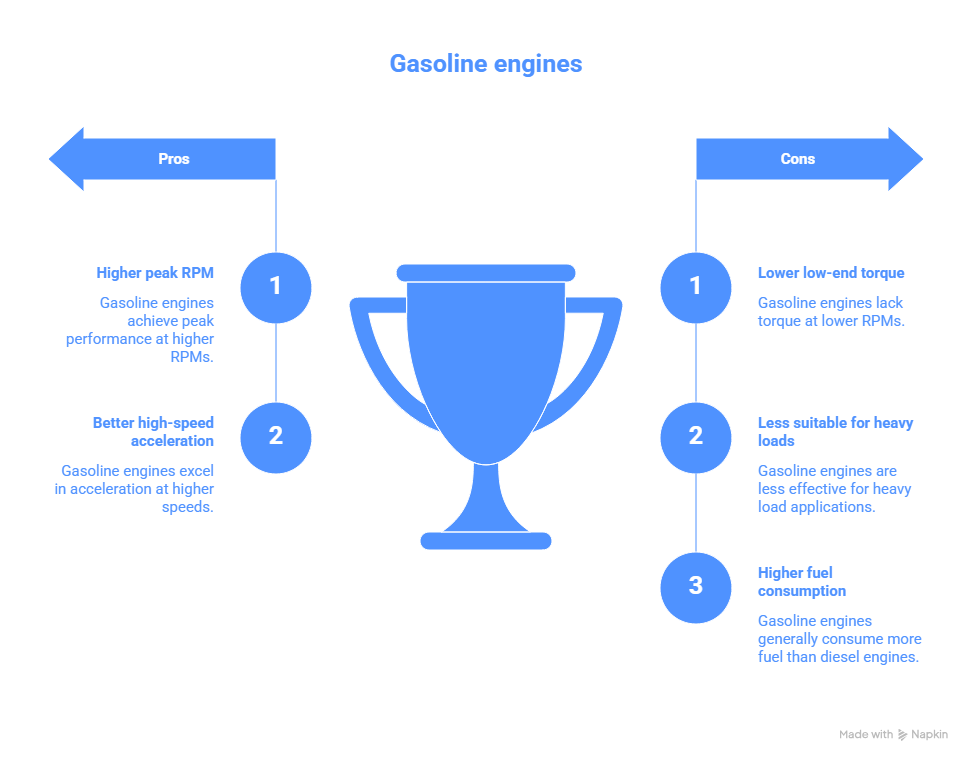
Gasoline engines, in contrast, tend to produce torque higher up in the RPM range. For instance, a typical gasoline engine might produce 200 lb-ft of torque at 4000 RPM. This characteristic means that gasoline engines often have higher RPMs when delivering their peak performance, but their torque is not as readily available at lower RPMs compared to diesel engines.
To make the most of this characteristic, gasoline engines often rely on shorter gear ratios, which allow them to quickly reach higher RPMs and access that torque when needed. For example, a shorter gear ratio (e.g., 2:1 or 3:1) in a gasoline engine allows for faster acceleration and better hill-climbing ability, as the engine can stay within its optimal power band at higher RPMs. These shorter ratios help keep the engine in its powerband by keeping the RPMs higher during acceleration, improving responsiveness on inclines or when passing.
When climbing a steep hill, for instance, a gasoline-powered car with a shorter gear ratio can maintain higher RPMs, delivering the needed torque to keep the car moving upward without losing speed or power. In contrast, a diesel engine may struggle in similar conditions, as its peak torque is often at lower RPMs, making it less responsive at higher engine speeds unless geared appropriately.
In the world of racing, gearing plays a pivotal role in achieving quick acceleration and optimal performance. One of the most common tactics is to use shorter final drive ratios in the differential to keep the engine RPMs high. This allows the engine to remain in its peak power band for rapid acceleration. For instance, a racing car may use a gear ratio of 3:1 or even lower to maximize the engine’s torque output during a race, providing instant power to the wheels as soon as the throttle is engaged.
The downside of this setup is that it sacrifices top speed. As the car accelerates and the RPMs climb, the engine may quickly reach its maximum RPM, limiting how fast the car can go, even if the vehicle is still accelerating. Racing cars often balance this by using taller gears for higher speeds on long straights but use shorter gears for sharp corners or acceleration zones where the car needs to maintain quick bursts of speed.
For example, in drag racing, a shorter final drive ratio enables faster launches and quicker acceleration times by keeping the engine RPMs high, but once the car reaches higher speeds, the engine might hit the redline more quickly, reducing overall top-end speed. This dynamic is what makes gear selection so critical for racing performance: it’s all about finding the right balance between acceleration and maximum speed.
- Diesel engines, with their high torque at low RPMs, require taller gearing to maintain efficiency at cruising speeds, which is great for long-distance driving and towing but not ideal for high-speed performance.
- Gasoline engines, with their higher torque at higher RPMs, benefit from shorter gear ratios that help them reach peak performance quickly, especially for activities like hill climbing or rapid acceleration on racetracks.
- Racing vehicles utilize shorter gear ratios for acceleration, focusing on keeping the engine in its optimal power range, but sacrifice top speed in exchange for quick bursts of power. This choice of gearing is essential in racing where split-second acceleration can make or break a race.
In conclusion, understanding the interconnection between horsepower, torque, and gearing is essential for optimizing vehicle performance. These three elements work together to determine how a vehicle accelerates, reaches top speed, and operates efficiently. Torque provides the initial force that propels the vehicle, horsepower measures how quickly that force is applied over time, and gearing adjusts the engine’s output to optimize the use of that power at different speeds.
To maximize a vehicle’s potential, it’s crucial to match the engine’s characteristics to the right gear ratios. For example, if you’re looking for quick acceleration, lower gear ratios (numerically higher) will help, while for highway cruising, higher gear ratios (like overdrive) are ideal to reduce RPM and improve fuel efficiency. Understanding these dynamics allows drivers to fine-tune their vehicle for various purposes, whether it’s for daily driving, racing, or towing heavy loads.
As you consider adjusting the gear ratios in your own vehicle, keep in mind that finding the right balance between torque and horsepower for your specific needs can dramatically improve performance and driving experience. Whether you’re looking to boost acceleration, improve fuel efficiency, or optimize top speed, gearing plays a pivotal role in achieving these goals.
1. What’s the difference between horsepower and torque?
Horsepower and torque are related but measure different aspects of an engine’s power. Torque refers to the rotational force an engine produces, which is responsible for moving the vehicle from a standstill or accelerating. Horsepower, on the other hand, measures how quickly that torque is applied over time. Simply put, torque gives you the force, and horsepower determines how fast that force can do work. The two are interconnected, and both are essential for optimal vehicle performance.
2. How do gear ratios affect vehicle performance?
Gear ratios determine how the engine’s torque is transferred to the wheels, influencing a vehicle’s acceleration and top speed. Lower gear ratios (numerically higher, like 4:1) multiply the engine’s torque to the wheels, improving acceleration but limiting top speed. Higher gear ratios (like 1:1 or overdrive) reduce wheel torque but allow for higher speeds at lower RPMs, helping preserve horsepower for long-distance driving or cruising.
3. Why do diesel engines need tall gearing?
Diesel engines are known for producing high low-end torque, often at lower RPMs. This makes them ideal for tasks like towing or hauling. However, to optimize fuel efficiency on highways and maintain a comfortable driving experience, tall gearing (higher numerical gear ratios like 3:1 or 4:1) is necessary. Tall gears allow the engine to run at lower RPMs, reducing fuel consumption and engine wear while maintaining highway speeds.
4. Can a car with high torque perform well on the highway?
While a car with high torque excels at low-speed acceleration, such as from a stop or when climbing hills, it may struggle on the highway without the right gearing. High torque at low RPMs can lead to inefficiency at sustained speeds. This is why high-torque engines often require taller gearing for highway driving, enabling them to maintain speed while keeping the engine RPM low for better fuel efficiency.
5. How do racing cars use gearing to improve performance?
In racing, shorter gear ratios (numerically lower, like 3:1) are often used to maximize acceleration. Shorter gears keep the engine RPM high, ensuring the car stays in its optimal power band for faster launches and quicker acceleration. However, this comes at the expense of top speed, as the engine quickly reaches its redline. Racing vehicles may use higher gear ratios for higher speeds on straights but shift to lower ratios for acceleration zones, balancing the need for speed and quick bursts of power.